“Hot Rats” : Frank Zappa’s Early Jazz Rock Masterpiece

Hot Rats by Frank Zappa. I can honestly say that this was one of the records that had a major impact on my life. I think I was around 12 years old when I was first heard it, an advantage of having an older brother with fairly hip taste for the time. I had already heard earlier Mothers Of Invention albums and liked them because they were weird and funny and I was also listening to records that featured long solos so there was also some sort of nascent interest in improvisational music. Hot Rats was one of those albums that just blew me away the moment I heard it and made me want to (somehow) make music like it.

Prior to Hot Rats, Zappa hadn’t really featured his guitar soloing very much. That changed with this record. The two longest tracks, Willie The Pimp and The Gumbo Variations, are jam type numbers with extensive solo space for Zappa’s guitar, as well as the electric violin of Don “Sugarcane” Harris and the sax of Ian Underwood. Here, Zappa the guitarist steps out and, as the saying goes, it’s a good thing. As a soloist, Zappa’s melodic and harmonic vocabulary were not especially out there, being very much based on blues and modal scales. It’s Zappa’s rhythmic conception that set him apart from practically all other guitarists. In a old Guitar Player Magazine interview, Zappa said that his rhythms were speech influenced and he played lines that featured a broad range of irregular rhythmic groupings. It was what made him sound like no other.

The remaining compositions on Hot Rats showcase Zappa’s genius as an orchestrator and Ian Underwood was the man who made it work. Underwood, the only holdover from the Mothers Of Invention, played the multiple reed and keyboard parts that are really what makes this music so great and certainly makes him the MVP of this record.

As I listened to this record again, I found myself returning most often to Son Of Mr. Green Genes. The piece is an instrumental re-arrangement of the song Mr. Green Genes from the Mothers Of Invention album Uncle Meat, and with it, Zappa created the perfect mix of an intricately arranged chart featuring Ian Underwood’s multiple overdubs and extended soloing by Frank.

Frank Zappa – Son Of Mr Green Genes


Where would I be if I never heard Hot Rats? I don’t know but I’m glad I’m here.
Tagged with: , , , , , ,
Posted in Improvisation, Jazz, Music Appreciation and Analysis

“All You Need Is Cash: . . : The Rutles – Best Beatles Parody Ever

I went to the doctor the other day. I know that this usually means a decent amount of time in the waiting room so I brought something to read, “You Never Give Me Your Money: The Beatles After The Breakup” by Peter Doggett. I haven’t gotten that deep into it yet but so far, it’s a pretty interesting read. Also, it didn’t take long for me to be reminded one of the best musical parodies ever, “All You Need Is Cash” by The Rutles.

The Rutles grew out of a comedy sketch show called Rutland Weekend Television that was written by Eric Idle (of Monty Python fame) with music by Neil Innes (from the Bonzo Dog Band and musical contributions to Monty Python). When Eric Idle hosted Saturday Night Live in 1977 and 1978, he showed some film clips from Rutland Weekend Television including those featuring the Rutles. SNL executive producer Lorne Michaels suggested that they extend the idea to a one hour show. The result was “All You Need Is Cash”.

From a history of comedy prospective, this show is interesting because it is a combination of Monty Python and first generation SNL. You had Idle, Innes and Michael Palin representing Monty Python and Dan Ackroyd, John Belushi, Bill Murray and Gilda Radner from SNL. Additionally, there were cameos from Paul Simon, Mick Jagger, Ron Wood and most significantly, George Harrison. You know something interesting is happening when one of the objects of your parody is actually in the parody itself. It’s all very meta. It also should be noted that the format of show was what we now call a mockumentary and was six years before “This Is Spinal Tap”.

Besides being hysterically funny to anyone familiar with the history of the Beatles, it’s musically brilliant in the way that the songs will remind you of specific Beatles tunes while actually being different from those tunes. This is so much more interesting that what someone like Weird Al Yankovic does which is to just put new words to existing songs (something that would be familiar to anyone who read Mad Magazine in the sixties).

So for your viewing pleasure, below is “All You Need Is Cash” featuring the Prefab Four, The Rutles.

Tagged with: , , , ,
Posted in Music Appreciation and Analysis

Cat Karma

Karma’s a bitch! As an animal lover all I can say is you go kitty!!

Tagged with: ,
Posted in Uncategorized

Altered States: Guitar Fretboard Logic Part VII

Hi Campers. Welcome to the final installment of my series on guitar fretboard logic. Last post, I talked about eleventh and thirteenth chords. At this point, if we extend the major scale any further, we would just be repeating notes. But we have been limiting our discussion to notes that occur naturally in the major scale. I’m not going to get into the construction of major scales, there’s a zillion music theory sites that can explain it but suffice to say that notes that are in a given major scale are said to be diatonic to the scale. So what about chords using tone colors that are not in the parent scale. We’re now talking about altered chords.
Let’s backtrack for a moment. When we get to seventh chords, there are three notes that really define the nature of that chord: the root, the third and the seventh. They determine the basic tonality, if the chord is major 0r minor and if it’s a major seventh or a dominant seventh. So we have the first, third and seventh notes of the scale accounted for. That leaves the second (or ninth), the fourth (or eleventh), the fifth and the sixth (or thirteenth). You can sharp or flat those notes, thereby altering them, and still maintain their basic character as a major or minor or dominant chord.
Every now and then I come see altered minor harmony but for the most part, I see altered chords based on major seventh and particularly, dominant seventh chords. The most common altered major seventh chord you will come across is the major seventh #11 chords. The formula for the chord is root, third, fifth. seventh and #11 of the major scale.

Scale Step      :  1  2  3  4  5   6   7   8  9 10 11 12 13 14 15
C major scale :  C D  E  F  G  A   B  C  D  E  F  G   A   B   C
Chord tones:    1 3  5  7 #11
C Major 7 #11:  C E G B F#

As I stated previously, when you play the diatonic eleventh, you are rubbing against the major third of the triad. You raise the eleventh interval by a half step (or one fret) to a #11 to mitigate the dissonance of that rub. The #11 does occur naturally in major seventh chords based on the fourth note of the major scale. That gets us into the topic of chords based on the harmonized major scale but that’s the basis of another series of posts that I will get into at a later date.

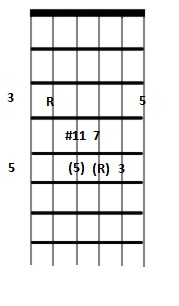
I tend to visualize the #11 as being one fret lower than a chord’s fifth (see diagram 1A). Many common grips of major 7 #11 chords actually replace the chords fifth with the # 11 to facilitate easier fingering (see diagram 1B).

 Diagram 1A
CMaj7#11_5thStringRoot
Diagram 1B
CMaj7#11_6thStringRoot
When you get to altered dominant seventh chords, you’re getting the whole kettle of fish. There’s seventh b9 chords, seventh #9 chords, seventh #11 chords, seventh flat 13 chords, seven flat 5, seven #5, combinations of the above and others. Why do you see so many altered dominant seventh chords? In functional harmony, the dominant seventh chord signifies the point of the most tension in a given key.  The dominant chord is usually built on the fifth degree of the scale and there is a very strong pull to resolve this tension by following the dominant chord (the V chord) with the chord built on the first degree of the scale (the I chord, also known as the tonic). It all comes down to tension and resolution. By chromatically altering the V chord, you are essentially doubling down on the harmonic tension in the chord progression which will be resolved when you get to the tonic chord.

At this point, I was hopefully clear enough in the previous posts for you to be able to figure out where you can locate the b9, #9, #11, b13 of any given chord anywhere on the guitar neck. A b9 is one fret above the chord root. A #9 is enharmonically synonymous (again with that tongue twister) with the flat third and is one fret lower the the major third. The b13 can be seen as one fret higher than the chord’s fifth. Basically it all comes down to this: If you know the five major triad chord shapes that cover the guitar fretboard and where the chord’s root, third and fifth are, you can extrapolate where all the other chord tones (diatonic and chromatic) are. I feel that this way of knowing the guitar neck will help your playing in the long term much more than memorizing scale patterns.

This series all started when some asked me what scales I use when improvising. This made me think about how I actually viewed the fretboard and I realized that I think in terms of chords rather than scales. I thought it might be helpful to others to share these thoughts and I hope it has.

Tagged with: , , ,
Posted in Guitar Logic, Music Theory

“To Infinity And Beyond”. . .: Guitar Fretboard Logic Part VI

In my previous post, I began to talk about chords with extended harmony. Extended harmony could be defined as intervals greater than an octave. Last post we talked about ninth chords. With this post we will discuss eleventh and thirteenth chords.

As we did with ninth chords, lets extend the major scale into the next octave:
Scale Step      :  1  2  3  4  5   6   7   8  9 10 11 12 13 14 15
C major scale :  C D  E  F  G  A   B  C  D  E  F  G   A   B   C

The interval of the eleventh is enharmonically the same as a fourth but when considering the eleventh interval played with a chord based on the major triad, we encounter a little problem. The eleventh (or fourth) “rubs” against the major third of the triad. It’s akin to playing a major triad and a suspended triad at the same time. That is why the eleventh interval is usually altered to a #11 (such as a C major 7 #11 or a C7 #11) when played against the major triad. By making the eleventh sharp, you eliminate that half step “rub” with the major third. I will discuss #11 chords in my next post when I talk about altered chords. Playing the eleventh with a minor chord is another story. Because the minor triad has a flatted third, there is no half step rub and as a result, minor eleventh chords are not as rare a sighting as a major or dominant eleventh chord.
Since the eleventh as synonymous with the fourth, I usually visualize the eleventh as two frets lower than the fifth. Taking a A minor 7th chord with the root on the sixth string as an example (diagram 1A), we can make it a A minor 11 chord by lowering one of the fifths (in this case, the one located on the fifth string) by two frets (diagram 1B).

Diagram 1A
A Minor 7_6thStringRoot
Diagram 1B
A Minor 11_6thStringRoot
For the sake of playable fingering, it’s sometimes necessary to replace the chord’s fifth with a different chord color, in this case the 11th. As I stated in a previous post, if the chord does not have an altered fifth interval (#5 of b5), then the chord’s fifth can usually be replaced

A thirteenth interval is enharmonically synonymous (how’s that for a tongue twister) with the interval of a sixth. A 13th chord can be differentiated from a sixth chord however by the presence of the 7th. If the chord has either a natural or a flatted 7th, the addition of the sixth would make it a 13th chord. Otherwise it would be considered a sixth chord.
As I do with the other intervals, I visualize the 13th interval in relation to the notes in the base triad. I look at the 13th (or 6th) as two frets higher than the chord’s perfect fifth.  In diagram 2A, we have a A7th chord with the root on the sixth string. To make it a 13th chord, I replace the fifth on the second string with the 13th two frets higher (see diagram 2B).

Diagram 2A
A7_6thStringRoot_2
Diagram 2B
A13th_6thStringRoot

Once again, your assignment (or whatever you want to call it) is to experiment with the other chord shapes. Identify where the chord’s elevenths and thirteenths (or fourths and sixths) are and come up with your own “grips” for 11th and 13th chords, major, minor and dominant.

Tagged with: , , , , , , ,
Posted in Guitar Logic, Music Theory

“If Two Were Nine . . .”: Guitar Fretboard Logic Part V

Thank you to all those who have stuck through my series of posts explaining my take of guitar fretboard logic. We started with using octave shapes to help in quickly identify the note at any point on the fretboard. We then discussed the idea of major triad chord shapes that interlock to cover the entire fretboard. We then expanded from the major triad chords to minor triads and seventh chords. In this post we go from seventh chords to chords of more extended harmony, specifically the 9th chords.

When you are talking about extended harmony, you are dealing with chords beyond seventh chords. Seventh chords, as we discussed in our previous post are made up of the root, the major or minor third, the fifth and the major or flatted seventh notes of a major scale:
Scale Step      :  1  2  3  4  5   6   7  8
C major scale :  C D  E  F  G  A  B  C
C Major 7 chord:  C  E  G  B
C Minor 7 chord:  C  Eb G Bb C
C Dominate 7 (C7): C  E G  Bb

If we extend the major scale into the next octave, we can think about adding notes beyond the seventh.
Scale Step      :  1  2  3  4  5   6   7   8  9 10 11 12 13 14 15
C major scale :  C D  E  F  G  A   B  C  D  E  F  G   A   B   C

So the next logical extension from seventh chords are ninth chords:
C Major 7 chord:  C  E  G  B D
C Minor 7 chord:  C  Eb G Bb D
C Dominate 7 (C7): C  E G  Bb D

The unaltered ninth interval is really the same as the second note in the scale, only an octave higher. For our purposes, they are enharmonically the same. To really sound a ninth chord color, you should include the seventh note. Otherwise it could imply more of a suspend 2 chord (a later post). The most common type of ninth chord is the dominant ninth chord. When someone says a C9th, they mean a C dominant 9th chord. It’s pretty much a cliche to call it “The Funk Chord” but it’s certainly a signifier of the funk guitar sound. You’ll also hear it used in T Bone Walker style blues.

I have found that the best way to learn the location of the 9th is to visualize it’s relationship to the notes in the triad chord form shapes. The 9th is two frets higher (a whole step in scale terms) than the chord’s root note and two frets lower (a whole step again) than the chord’s major third or one fret lower than the flatted third interval in a minor chord.
The most common chord shape for a 9th chord can be derived from the major triad chord shape with the root on the fifth string (diagram 1A):

Diagram 1A
A Major Chord_5thStringRoot_1

Using a the A major chord with the root played on the fifth string, 12th fret as an example, you could get the flatted 7th by replacing the chord’s fifth on the G (3rd) string with the flatted 7th which is 3 frets higher (diagram 1B). Due to the nature of the guitar fretboard, it’s sometimes necessary to not include every note that technically should be played. If the chord does not have an altered fifth interval (#5 of b5), then the chord’s fifth is usually dispensable.

Diagram 1B
A7_5thStringRoot_1

Finally, you can then add the 9th to the chord by replacing the root note on the B string with the 9th two frets higher (diagram 1C):

Diagram 1C
A9th_5th StringRoot
As I said earlier, the best way to familiarize yourself with the 9th is to go over the five chord shapes and identify the interval relative to the chord’s root and third.

Let’s look at a minor ninth chord. Using the A minor chord with the root on the sixth string as a starting point (diagram 2A), you can add the flatted seventh by lowering the chord’s fourth string root note by two frets, giving the flatted seventh, and adding the ninth by replacing the root on the first string with the ninth two frets higher (diagram 2B)

Diagram 2A
A Minor Chord_6thStringRoot_2
Diagram 2B

A Minor 9_6thStringRoot
The major ninth chord is an extension of the major seventh chord. You can take a major triad chord form (diagram 3A), lower one of the root notes by one fret to get the major seventh and raise another root note by two frets to get the ninth interval (diagram 3B).

Diagram 3A
A Major Chord_6thStringRoot_2
Diagram 3B
A Major 9_6thStringRoot

As I have said before (and I will keeping repeating till we’re all sick of it), experiment with this. Take a major triad chord shape and fool around with it. Identify where the major thirds are and lower them by a fret get the minor triad. Lower a root note by one fret to get the major seventh. Lower the root by two frets to get the flatted seventh. Raise the root by two frets to get the ninth. Your knowledge of the fretboard will improve dramatically.

Tagged with: , , , , ,
Posted in Guitar Logic, Music Theory

Three Will Get You Four: Guitar Fretboard Logic Part IV

We are continuing our discussion of guitar fretboard harmony. In previous posts, I outlined how you can play a given major chord anywhere along the guitar neck. We then saw how you can convert the major chord into a minor chord by lowering the major third of the chord to a minor third. These chords are known as triads because they are made of three notes: the chord’s root, third and fifth. If these terms are strange to you then let’s briefly discuss chord formula.

Chords are derived from scales. I use the major scale as my starting point. There are music theory texts that derive major chords from the major scale and minor chords from a minor scale but I always felt that such a method was unnecessarily complicated. So I get a major triad chord by using the first note of scale (the root), the third note of the scale (the major third) and the fifth note of the scale. A minor triad chord is made up of the first note, the flatted third and fifth note of the major scale. For example:

Scale Step      :  1  2  3  4  5   6   7  8
C major scale :  C  D E  F  G  A   B  C
C Major chord:  C  E  G
C Minor chord:  C  Eb G

You can expand a triad chord by adding the seventh note of the scale to the chord, hence the term “seventh chord”. For now, we will limit our discussion to three types of seventh chords: major seventh, minor seventh and dominant seventh.
The major 7 chord is simply the first, third, fifth and seventh notes of the major scale. The minor 7 chord is the first, flatted third, fifth and flatted seventh notes of the major scale. The dominant 7 chord, which is referred to just as a seventh chord, is the first, third, fifth and flatted seventh notes of the major scale.

Scale Step      :  1  2  3  4  5   6   7  8
C major scale :  C D  E  F  G  A  B  C
C Major 7 chord:  C  E  G  B
C Minor 7 chord:  C  Eb G Bb
C Dominate 7 (C7): C  E G  Bb

All this stuff about chord formula is fine and dandy but how does this relate to the chord shapes that we have talked about? You can add the 7th note to the chord but due to the layout of the fretboard, making a triad chord shape into a seventh chord is usually a matter of identifying the root note in the shape and lowering it either by one or two frets (depending on type of seventh chord you’re going for). As an example, look at Diagrams 1A and 1B below:

Diagram 1A
A Major Chord_6thStringRoot_2
Diagram 1B
A Major 7_6thStringRoot_2
Diagram 1A is a A major triad with it’s root on the sixth string. Diagram 1B is a A major 7 chord that was derived from the major triad in diagram 1A. Notice that you can get the major 7th of the chord by lowering the root note on the fifth string one fret or by lowering the root on the first string by one fret (you can also modify the root on the sixth string but it sounds muddy and the tone color imparted by the major 7th will be rather indistinct). I showed the chord’s fifth (on the fifth string) in parenthesis because it’s usually not played when using this “grip”. The root notes on the first and fourth strings are in parenthesis for reference.

Diagrams 2A and 2B show the difference between the A major triad with it’s root on the sixth string and a A7th chord.

Diagram 2A
A Major Chord_6thStringRoot_2
Diagram 2B
A7_6thStringRoot_2
Dominant 7th chords are referred to as 7th chords. When your lead sheet says C7, they mean C dominant 7. The easiest way to get the dominant 7 chord is to lower a root note by two frets. That’s what being done in diagram 2B on the fourth string. You’re playing the flat 7th by lowering the root on the fourth string by two frets. You can also play the flat 7th one octave higher on the second string.

Minor 7th chords can be derived from the major triad shape by lowering the chord’s third by one fret and lowering a root note by two frets.

Diagram 3A

A Major Chord_6thStringRoot_2
Diagram 3B
A Minor 7th Chord_6thStringRoot_2
Here we lowered the major third on the third string by one fret, thereby making the chord minor, and got the flat seventh by lowering the root note on the fourth string by two frets, making it a minor 7th chord. You also have the option of replacing the chord’s fifth (located on the second string) with the flatted seventh.

Please experiment with deriving major 7th, minor 7th and dominant 7th chord shapes from the other major chord forms that I talked about in previous posts. That’s the best way to internalize all this stuff. This way you will eventually be able to look at the guitar fretboard and be able to identify where is the fifth of a Eb minor 7th anywhere (6th string/6th fret, 5th string/first or 13th fret, 4th string/8th fret, 3rd string/3rd or 15th fret, 2nd string/11th fret and first string/6th fret).

Tagged with: , , , ,
Posted in Guitar Logic, Music Theory

Major To Minor: Guitar Fretboard Logic Part III

In my previous post, I discussed how one can use five interlocking chord shapes to play a given major chord along the entire guitar neck. While currently being referred to as the CAGED system (because the shapes correspond to the basic “cowboy chord” shapes of C major, A major, G major, etc.), I prefer to organize the shapes by the string where the chord root is located. Also, by becoming familiar with the function (root, major third, fifth) of each note in the shape, one can begin to expand the basic major triad into any number of advanced chord voicings.
I ended the last post talking about how to get a minor triad chord shape from a major chord. This takes us to the land of chord formulas. I prefer to derive my chords from your basic major scale. A major triad chord is made up of the root, third and fifth of a major scale. The minor triad chord is made up of the root, flatted third and fifth of the major scale. How do you flat a third? In music theory terms, you lower the note by a half step (on a piano, the next lowest key). In guitar terms, just lower the note by one fret. As a example, compare the diagrams below:

Diagram 1 – A Major chord with root on fifth string
A Major Chord_5thStringRoot_2
Diagram 2 – A Minor chord with root on fifth string
A Minor Chord_5thStringRoot_2
By lowering the note on the second string by one fret (from 14th fret to the 13th), you changed the note that was the major third of the chord to the minor third, making it now a A minor triad. below is another example:

Diagram 3 – A Major chord with root on sixth string
A Major Chord_6thStringRoot_2
Diagram 4 – A Minor chord with root on sixth string
A Minor Chord_6thStringRoot_2
By lower the note on the third string by one fret, you flatted the chord’s major third making it a minor triad. I recommend going through the exercise of deriving minor triad chord shapes from the other major chord shapes. It will only help you master fretboard harmony that much faster.

The quality of a chord’s third is essential to determining if a chord is a major or a minor triad. It’s important to note that a defining element of what we hear as the blues is the friction one hears between playing the minor third of a chord melodically against the harmony of a major chord.

Next post, we’ll move from triads to our first group of extended chords: the major seventh, the minor seventh and the dominant seventh chords.

Tagged with: , , ,
Posted in Guitar Logic, Music Theory

“If You Lived Here, You’d Be Home By Now”: Guitar Fretboard Logic Part II

In my previous post, I discussed how one could use octave shapes to learn the notes on the guitar fretboard. I would like to continue by talking about chord shapes. The layout of the fretboard allows you to play a given chord at multiple locations along the guitar neck. By becoming familiar with these interlocking shapes, you will be able to play the chord anywhere on the fretboard. Further more, knowing the role that a given note has in that chord shape will have an invaluable effect on your ability to solo effectively.
When I was first learning chord shapes, I conceptualized it as chords whose roots were on the sixth, fifth and fourth strings respectively. I then realized that the shapes dovetailed together with the notes common to both forms providing a way to mentally link the forms.
Lets start with chord shapes where the root note is on the sixth string (diagrams 1 and 2 below).
Note: All the chord shape examples are assuming an A major chord.

Diagram 1 – Root on sixth string shape 1
A Major Chord_6thStringRoot_1
Diagram 2 – Root on sixth string shape 2
A Major Chord_6thStringRoot_2
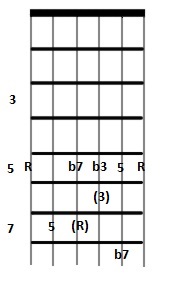
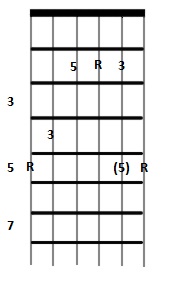
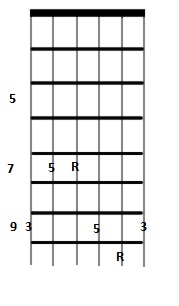
Notice that both shapes share the chord’s root and major fifth (in the case of the A major chord, on the 5th fret). In diagram 1, I put the major fifth that occurs on the second string in parenthesis as a way of showing that it is a note common to both shapes but is usually not played as part of the chord shape (to do so would eliminate the chord’s major third). Also take note of the octave shapes that occur in each chord shapes both within a given shape and between the two interlocking shapes.
The chord shape in diagram 3 below shows an A major chord whose root occurs on the fourth string (here at the 7th fret).

Diagram 3 – Root on fourth string
A Major Chord_4thStringRoot
The shapes in diagrams 2 and 3  share the root and fifth of the chord (here at the 7th fret). This shape is rarely played as a chord since it would be very difficult to finger but is still important to know as it provides a link between the chord shape in diagram 2 and the the chord shape in diagram 4 below whose root note occurs on the fifth string. The fourth string root shape also become more useful when it is modified to a seventh chord (more of this next post).

Diagram 4 – Root on fifth string shape 1
A Major Chord_5thStringRoot_1
The link between the shapes of diagram 3 and 4 involve the chord’s major third and fifth (here at the 9th fret) as well as the chord root (at the 10th fret). Once again, the notes in parenthesis show that it is common to an adjacent shape but is usually not played. Finally, there is the chord shape in diagram 5 below.

Diagram 5 – Root on fifth string shape 2
A Major Chord_5thStringRoot_2
Here, the root and the fifth occurring on the sixth, fifth and first strings are the linking tones with the previous shape. Going further up the guitar neck, we see that this shapes connects to the chord shape of diagram 1 but an octave higher.
So there you have it. By knowing these five shapes and being aware of how they connect together, you can play a major chord over the entire range of the guitar neck. You may notice that if you follow a specific string from one shape to the next up the neck, you will be going up the chord tones of the triad. The root note on the third string in diagram 1 moves up to the major third in the diagram 2 shape which moves up to the chord’s fifth in the diagram 3 shape and so forth. I was first introduced to these concepts when I took a couple of lessons from the jazz guitarist Alan de Mause in the 70’s. He organized these shapes in terms of root note by string. I have noticed that in recent years that a lot of  guitar instructional material organize these forms as the CAGED system. I find that the root by string system works better for me because it gives me a better grasp of the big fretboard picture but that’s my personal preference.
By being aware of what notes are the root, major third and fifth of the chord in a given shapes, you can begin to derive other types of chords. I will get more deeply into this in the next post but as a start, lets talk briefly about how to get minor chord shapes from these major chord shapes.
A major triad chord is made up of the root, third and fifth of a major scale. The minor triad chord is made up of the root, flatted third and fifth of the major scale. How do you flat a third? Just lower the third of a major chord by one fret. As an example, to make the major chord in diagram 5 a minor chord, lower the third that occurs on the second string by on fret (see diagram 6 below).

Diagram 6
A Minor Chord_5thStringRoot_2
I hope this makes sense to those kind enough to stick with me this far. I also hope that his helps you begin to get a clearer picture of the guitar fretboard. In my next post, I will discuss expanding these triad chord shapes to major, minor and dominant seventh chords.

Tagged with: , ,
Posted in Guitar Logic, Improvisation, Music Theory

“Where The Heck Are We?”: Guitar Fretboard Logic Part I

There’s nothing like trying to explain basic concepts of the guitar to a beginner to help you clarify your own musical thought processes. This is the case as I try to show my nephew some stuff on guitar. I’ve been playing for over 40 years and one of the things that I take for granted as I talk to beginning (or even some intermediate) guitarists is knowing where any note is on the guitar fretboard. They may know what the notes are on the sixth and fifth strings if they are familiar with barre chords but if you asked them what is the note on the fourth string, sixth fret, there’s a good chance that they wouldn’t know (it’s A flat by the way). If you want to stick to simple “cowboy” chords, it’s not that important but this trait also shows up in guitarists who have begun to explore soloing and are basing their solos on some sort of pattern. They know that if they are suppose to be in key X, then if they use guitar pattern Y at fret Z, then they’ll be able to play something in the general ballpark of a solo. It’s no surprise that these solos tend to sound stilted and mechanical. It’s like reciting a speech phonetically in a foreign language, without understanding what you’re saying. Your ultimate goal should be knowing where you are on the fretboard and what is that note’s relationship to the underlying harmony of the music you are playing. It’s knowing that the A flat note on the fourth string, sixth fret is the root if you’re playing over a A flat dominant seventh (Ab7) or that it’s the third if you are playing over a F minor chord or the flat 7th of the B flat dominant 7 (Bb7).
This may sound daunting but it’s not as hard as you think. I believe the key is viewing the fretboard in terms of chord forms as opposed to scale patterns. If you know the basic forms and the role the individual notes have in that chord form, you will have a much better understanding of the fretboard and what you’re playing. The first step in that process goes back to knowing where any given note is on the fretboard. If you are trying to play a G minor 7 chord somewhere around the 9th fret, you need to know where the note G is at that part of the neck. It all starts with the root.
What I found to be a good way to internalize the locations of a given note is to use octaves shapes. By knowing the notes on the sixth and fifth strings, you can then extrapolate where these notes are on the other strings. As I said earlier, if you gotten to the stage where you can play barre chords, you should know the notes on the sixth and fifth strings. If not, here is a quickie chart:

Fret        6th String     5th String
open            E                     A
1                  F                     Bb
2                  F#(Gb)            B
3                  G                     C
4                  G#(Ab)           C#(Db)
5                  A                     D
6                  A#(Bb)           D#(Eb)
7                  B                     E
8                  C                     F
9                  C#(Db)           F#(Gb)
10                D                     G
11                D#(Eb)           G#(Ab)
12                 E                      A
(The notes on the 12th fret of the guitar are the same as the open strings one octave higher.)

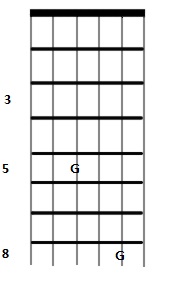
With octave shapes, you can use the notes on the sixth string to figure out the notes on the fourth string. Knowing that the note on the sixth string, 3rd fret is a G, you can see that the note on the fourth string, 5th fret is also a G, one octave higher (see diagram).
Octave Diagram 1
The same octave shape applies to the fifth and third strings.  Knowing that the note on the fifth string, 3rd fret is a C, you can see that the note on the third string, 5th fret is also a C, one octave higher (see diagram).
Octave Diagram 2
Another octave shape exists between the fifth string and the second string:
Octave Diagram 5
Same basic shape exists between the fourth and first strings:
Octave Diagram 3
One more basic shape, between the fourth and second string and the third and first strings respectively:
Octave Diagram 4
Octave Diagram 6
Please also note that the notes on the first string are two octaves above the notes on the sixth string. Knowing these shapes will help you to learn where any note is on the fretboard. My next post will build on this by introducing chord shapes based on a given note.

Tagged with: ,
Posted in Guitar Logic, Music Theory
Archive
Follow ManRoy Music on WordPress.com

Enter your email address to follow this blog and receive notifications of new posts by email.